Updated: October 14, 2026
T-money, Climate Card, and WOWPASS often appear in the same travel-card comparisons, but they serve different purposes.
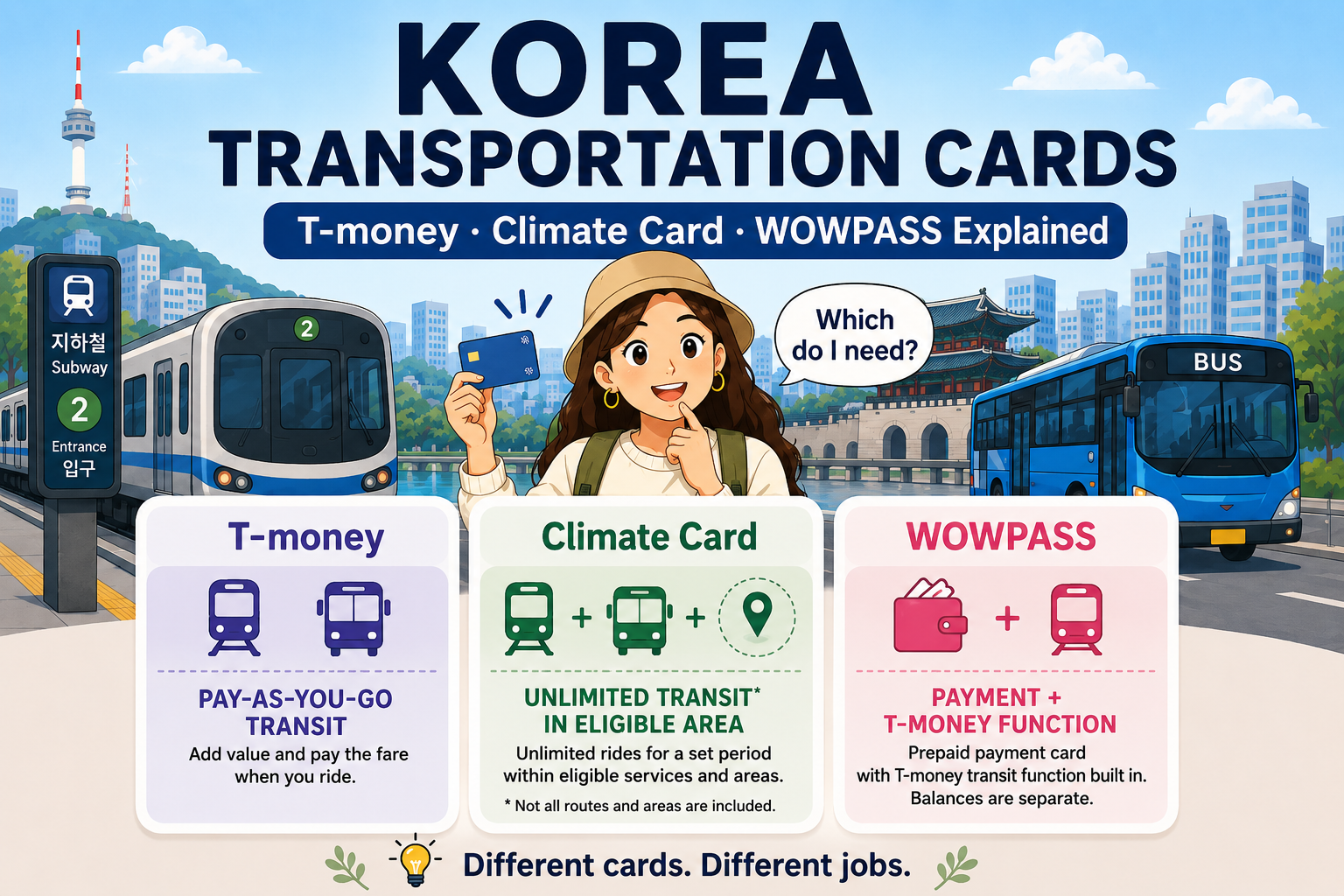
T-money lets you pay as you travel. WOWPASS adds prepaid shopping payments to a card with a T-money transport function. The Climate Card is a time-limited pass for covered public transport.
You don’t need to buy all three. Start with where you’re going and how you want to pay.
Quick answer
T-money
Pay as you go on supported public transport. A straightforward starting point if you want flexibility or haven’t settled your itinerary.
WOWPASS
Prepaid payments and a built-in T-money transport function. Worth considering if you also want its shopping and currency features. The payment and transport balances are separate.
Climate Card
Unlimited travel on covered services for a set period. Check your routes first, then compare the pass price with what you expect to spend on those journeys.
Already have WOWPASS? You generally don’t need another physical T-money card for yourself. Check that its transport balance has enough money before traveling.
Still preparing for your arrival? Start with the Incheon Airport Arrival Guide.
1. T-money: pay for the journeys you take
A standard T-money card stores money. When you use it on a supported service, the fare is deducted from that balance.
It suits travelers who want flexibility without choosing an unlimited pass in advance.
You can buy and top up physical cards at participating convenience stores, and use supported station machines to add value. The card’s purchase price and the money loaded for travel are separate costs.
Keep some Korean won available for conventional top-ups rather than assuming every machine or shop will accept your overseas bank card.
When I’d start with T-money
I’d consider it first if:
- Your itinerary is still changing.
- You’re visiting several cities.
- You expect to walk a lot and take occasional public transport.
- You already have a payment method you’re happy using for shops and restaurants.
Acceptance is broad, but that doesn’t make it a ticket for every train or bus. Check separately for reserved intercity services and airport products such as AREX Express.
2. WOWPASS: payments and transport on one card
WOWPASS is a prepaid payment product for international visitors. Its physical card also includes a T-money transport function.
The reason to consider it is whether you want the payment features as well as transport—not whether you need another card for the subway.
Before purchasing, compare the current issuance charge, exchange rate, top-up fees, and withdrawal conditions with the payment options you already have.
One card, two balances
The important distinction is:
- WOWPASS payment balance: Used for supported shopping and other card payments.
- T-money transport balance: Used by the card’s transport function.
Adding money to the payment balance does not automatically mean the transport balance is ready for a journey.
WOWPASS currently advertises transport-balance checking and top-ups through its app. Follow the app’s instructions and check device requirements and any charges before relying on that method.
Do you need a separate T-money card?
Usually not for your own travel if you’re already using the T-money function in WOWPASS.
Buying another physical card would duplicate that function. Another traveler, however, should have their own suitable transport card for independent journeys.
3. Climate Card: check the routes before the price
The Climate Card short-term pass covers eligible subway and bus travel for a selected period.
Use the current service map. Seoul’s October 2026 guidance defines coverage around Seoul subway services and Seoul-licensed city and village buses, with specific exceptions.
It excludes services such as Shinbundang, GTX, and airport buses.
For the airport railway, eligible journeys can end at Incheon Airport T1 or T2, but you cannot board there using the Climate Card. It is not your arrival ticket into Seoul.
This guide focuses on the short-term visitor passes. Older explanations of the 30-day product should not be used as instructions for buying one now.
Short-term pass prices
The standard prices listed when checked on October 14, 2026 were:
| Pass | Price |
|---|---|
| 1 day | ₩5,000 |
| 2 days | ₩8,000 |
| 3 days | ₩10,000 |
| 5 days | ₩15,000 |
| 7 days | ₩20,000 |
A physical card costs an additional ₩3,000 if you need one. These are standard prices; check any separate discount eligibility before buying.
When does the pass start?
The short-term pass starts on the day it is loaded. Don’t assume a one-day pass gives you a rolling 24 hours from your first ride.
Check the displayed expiry before paying, especially if you’re loading it late in the day.
Buying and using it
Physical cards are available through designated station facilities and participating shops. Purchase and loading arrangements can vary by location.
Check the payment methods offered at the specific machine or counter. Don’t assume your overseas card will work everywhere.
Keep the Climate Card separate from other contactless cards when tapping. Follow the entry and exit procedures, including tapping off the bus.
If you travel outside the eligible network, you may need to pay separately. Check both ends of the route before boarding.
4. Is the Climate Card cheaper for your trip?
Compare the cost of the pass and any new physical card with the fares you would otherwise pay for covered journeys.
For example, a standard five-day pass plus a new physical card totals:
₩15,000 + ₩3,000 = ₩18,000
If you already own a usable physical card, that purchase cost doesn’t apply again.
Next, estimate your likely pay-as-you-go spending over those days. Include transfer discounts where applicable: two vehicles in one connected journey don’t necessarily mean two full fares.
Also account for journeys outside the pass coverage. You’ll still need another way to pay for those.
There’s no reliable rule that a five-day stay automatically makes a five-day pass worthwhile. Someone exploring one neighborhood on foot may spend much less on transport than someone crossing the city several times a day.
5. Which setup would I choose?
Mostly transport, with flexible plans
I’d start with a standard T-money card if I didn’t already have a suitable transport card.
It keeps the decision simple while leaving room for the itinerary to change.
Already planning to use WOWPASS
I’d use its built-in T-money function and check the transport balance before boarding.
There’s little reason to buy another card for the same purpose without a specific need.
Several busy sightseeing days on covered routes
I’d compare a Climate Card pass with the expected pay-as-you-go cost.
Coverage comes first. A pass that saves money on paper is less useful if several planned journeys fall outside its network.
Seoul plus other cities
I’d plan a pay-as-you-go option for everyday local transport and buy any required intercity tickets separately.
A Seoul-focused pass might still suit part of the stay, but it wouldn’t replace the rest of the travel budget.
Song’s Local Note
I’d decide on a transport card after marking the places I actually want to visit.
A day spent walking around a neighborhood and a day with several trips across Seoul call for different calculations. You don’t have to choose a pass just because it matches the number of nights on your booking.
The useful question is how much you’ll travel during its valid period.
Quick FAQ
Do I need all three cards?
No. Choose the functions you need. T-money and WOWPASS overlap for transport, while the Climate Card serves a different purpose.
Does topping up WOWPASS also top up T-money?
Not automatically. Check the transport balance separately and complete the relevant top-up process.
Can I use the Climate Card from Incheon Airport into Seoul?
No. The airport-station exception allows eligible journeys to end at T1 or T2; it does not allow boarding there with the pass.
Compare your arrival options in our AREX vs Airport Bus vs Taxi guide.
Can I use more than one type during the trip?
Yes. For example, you might use a Climate Card for covered sightseeing days and a pay-as-you-go card for other journeys.
Keep track of which card you use, and use the same one to complete a journey.
Should I load a large amount onto a transport card?
I’d start with an amount suited to the next part of the trip. Check the refund process before loading more than you expect to spend.
Different products have different refund conditions, and the physical card’s purchase price is separate from its usable balance.
Before buying
Korea Tourism Organization — transportation cards
WOWPASS official website and app information
Seoul Metropolitan Government — Climate Card details and coverage (Korean; use browser translation) →
You need a way to pay for your journeys—not a collection of every travel card available.
Anything still unclear?
Tell me which part left you with questions. Your feedback helps me improve this guide.
Email Song → asdcxz8864@gmail.com
1 thought on “Korea Transportation Cards Explained: T-money, Climate Card & WOWPASS”
Comments are closed.