Updated: October 14, 2026
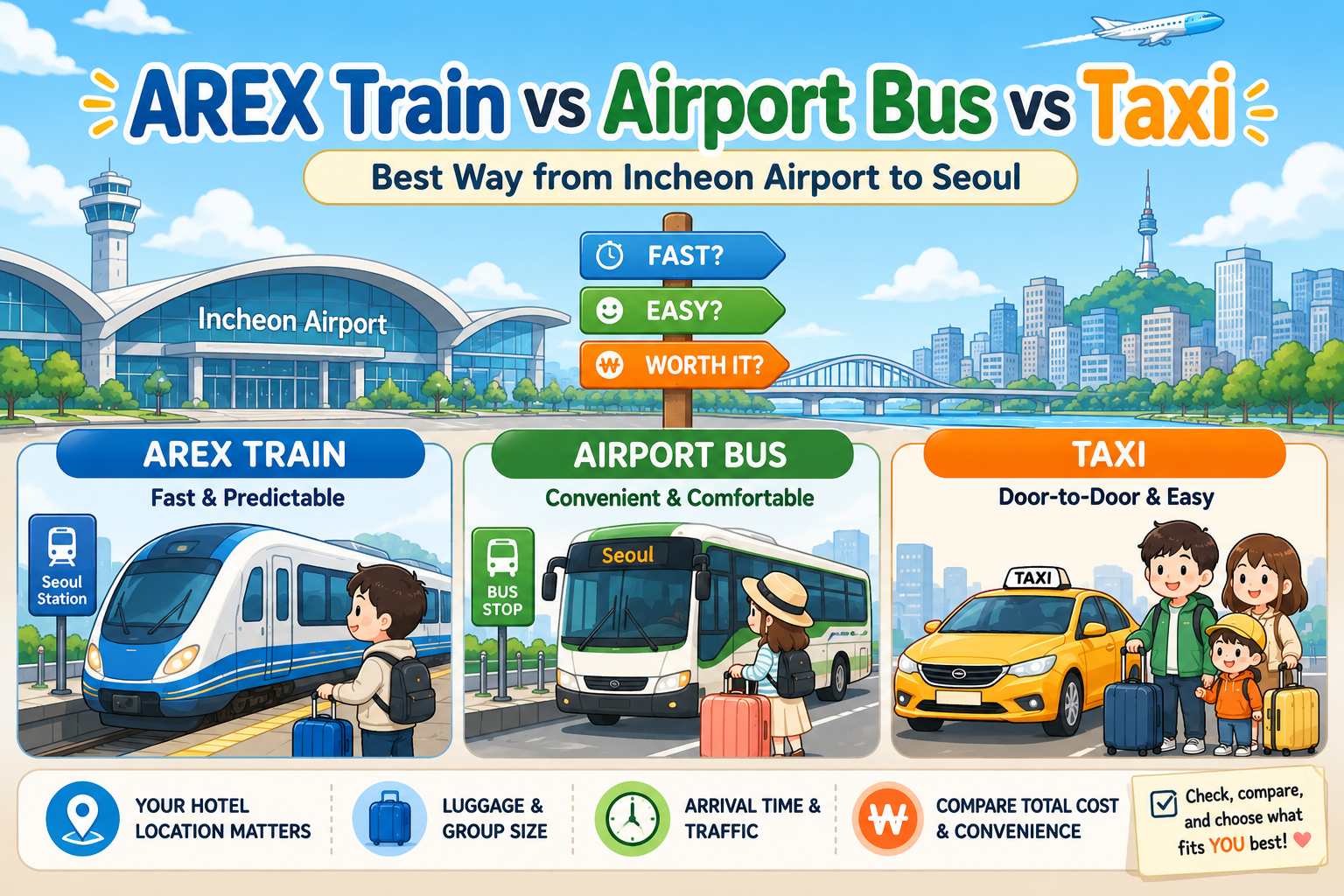
Your hotel’s location is the best place to start when choosing between AREX, an airport bus, and a taxi.
The train can avoid traffic, the bus may save you a transfer, and a taxi can take you directly to your accommodation. Which one makes sense depends on the rest of the journey: your luggage, your group, and the time you’re ready to leave the airport.
Quick answer
| Your situation | Check first |
|---|---|
| Staying near Seoul Station | AREX Express and All-Stop |
| Staying near Hongik University or Gongdeok station | AREX All-Stop |
| Airport bus stops close to your accommodation | Airport bus |
| Traveling with several people and large bags | A taxi with enough passenger and luggage space |
| Want to avoid road-traffic delays | AREX |
| Arriving after regular services finish | Available late-night buses and taxis |
Before buying anything, save your accommodation’s Korean address and check the route from your arrival terminal.
Include the walk from the final station or bus stop. That last part can change your decision.
For help getting connected and preparing to leave the terminal, start with the Incheon Airport Arrival Guide.
1. AREX: Express or All-Stop?
AREX has two services worth checking. Don’t buy an Express ticket simply because you’re heading to Seoul.
AREX Express
The Express connects the airport terminals and Seoul Station without the intermediate stops served by the All-Stop train. It uses a dedicated Express ticket.
It’s worth considering if Seoul Station is convenient for your accommodation or your onward connection.
You’ll avoid road traffic, but you still need to account for the time spent reaching the station, waiting for departure, and getting from Seoul Station to your hotel.
AREX All-Stop
The All-Stop train calls at intermediate stations, including Hongik University and Gongdeok.
If you’re staying near one of those stations, it may give you a simpler journey than taking the Express to Seoul Station and traveling back.
You can use an accepted transport card or buy a single-journey ticket. Check the current fare for your arrival terminal and destination.
Which train should you choose?
If both services work for your accommodation, compare the next departure, fare, and total journey.
For Hongdae, start by checking the All-Stop route to Hongik University station. For Seoul Station, compare both services rather than assuming the Express is your only option.
A shorter train ride doesn’t always mean an earlier hotel arrival. Waiting time and the final connection matter too.
2. Airport bus: useful when the stop is close
An airport bus is worth checking when it stops near your accommodation and saves you a train transfer.
Airport limousine coaches generally have luggage compartments, which can make the journey easier with a suitcase. Check the operator’s baggage rules if you’re carrying several bags or oversized items.
Before choosing the bus
Confirm:
- The route serves your arrival terminal.
- The destination stop is the one you need.
- A departure is available when you expect to leave the airport.
- The walk from the stop to your accommodation is manageable.
- You understand the ticket or reservation arrangements.
A stop described as “near the hotel” may still involve a busy crossing, stairs, or an uphill walk. Look at the actual route.
The trade-off is traffic
Bus journey times depend on the route and road conditions.
If you have a time-sensitive onward connection, allow room for delays. If your priority is avoiding transfers with luggage, a direct bus may still be the more comfortable choice.
Compare the whole journey rather than choosing by vehicle alone.
3. Taxi: direct travel, with a higher total cost
A taxi is worth comparing when your accommodation is awkward to reach by public transport, you’re arriving late, or a direct ride matters more than the lowest fare.
For a group, compare the total vehicle cost with everyone’s train or bus tickets and any onward transport.
Check capacity before comparing prices
Four passengers and four large suitcases may not fit in a standard taxi.
You may need a larger vehicle or more than one taxi, which changes the cost comparison. Give a booking provider the number of passengers and the size and number of bags.
If you need a child seat, wheelchair access, or help transferring into a vehicle, confirm those arrangements in advance. A standard taxi or coach may not meet those needs.
What affects the fare?
For a metered taxi, the final amount depends on the destination, distance, traffic, vehicle category, and applicable surcharges or tolls.
For a pre-booked service, check whether the quoted price is fixed and what it includes. Waiting time, tolls, and extra stops may be handled differently.
An app estimate is useful for comparison, but it isn’t necessarily a guaranteed price.
Use the airport’s designated taxi stands or follow the pickup instructions from your booked service.
Late-night surcharges
At the October 14, 2026 check, Incheon Airport’s official guide listed these surcharges for standard Seoul taxis:
| Time | Night surcharge |
|---|---|
| 22:00–23:00 | 20% |
| 23:00–02:00 | 40% |
| 02:00–04:00 | 20% |
These are the published night-surcharge rates for that taxi category, not a complete airport-to-hotel price. Other vehicle categories and booked services can have different pricing.
Check the current rules when planning a late arrival.
4. Arriving late at night
Plan around the time you expect to reach the public arrivals hall, not just the flight’s landing time.
Immigration, baggage collection, and customs all happen before you can head to your transport.
Incheon Airport lists dedicated late-night bus services. Whether one works for you depends on your terminal, destination, and departure time.
Compare:
- The next available bus and its destination stop
- The wait until departure
- How you’ll get from that stop to your accommodation
- A suitable taxi and its estimated total cost
A late-night bus can be useful, but a distant final stop may leave you needing another ride. Check that connection before buying the ticket.
Keep your accommodation’s late-check-in instructions available offline.
Song’s Local Note
If a friend asked me which option to take, I’d start by looking at the walk from the final stop to their accommodation.
A route with one extra transfer might be fine with a backpack and much less appealing with two suitcases. A bus stop a little farther away could still be easier if the walk is flat and straightforward.
For travelers with mobility needs, check the specific station exits, lifts, boarding arrangements, and vehicle accessibility. Fewer transfers alone doesn’t guarantee an accessible journey.
How I’d narrow it down
Staying near Hongik University or Gongdeok station:
I’d check the All-Stop train first.
Staying near Seoul Station:
I’d compare the Express and All-Stop departures and fares.
A bus stops close to the accommodation:
I’d compare that journey with the train, especially if the train involves transfers.
Traveling as a group with several bags:
I’d get a quote for a vehicle that can actually carry everyone and the luggage.
Arriving around midnight:
I’d check the late-night bus options and keep a taxi alternative ready.
These are starting points. Your exact address and the services available when you arrive should decide the final choice.
Quick FAQ
Is AREX faster than an airport bus?
Rail avoids road traffic, so the train portion is more predictable. Your hotel arrival time still depends on waiting, transfers, and the final walk.
Is Express always better than All-Stop?
No. All-Stop serves intermediate stations that may be closer to your accommodation. Compare your destination rather than the service names.
Is a taxi cheaper for four people?
It can be worth comparing, but don’t assume it will be cheaper. Check the full fare and whether your group and bags fit in one vehicle.
Should I buy a transport card before choosing my route?
Choose the route first. Express has its own ticket, All-Stop has a single-journey option, and a taxi ride doesn’t require a public-transport card.
For the differences between T-money, WOWPASS, and the Climate Card, see our Korea transportation cards guide.
Does Terminal 1 or Terminal 2 matter?
Yes. Departure times, boarding locations, travel times, and some fares can differ. Use the terminal shown in your current flight information.
Before you leave the arrivals hall
Incheon Airport transport information
Seoul late-night buses — Terminal 1
Arriving at Terminal 2? Select “Late-night Bus (Terminal 2)” on the airport website.
Anything still unclear?
Tell me which part left you with questions. Your feedback helps me improve this guide.
Email Song → asdcxz8864@gmail.com
1 thought on “AREX vs Airport Bus vs Taxi: Best Way from Incheon Airport to Seoul”
Comments are closed.